Here’s the excerpt from our Starflight Rudder Pedals Installation Guide regarding the installation of the floor boards or not.
Valin Thorn
Legacy Project (yes still a project -- no more mod’s…)
Boulder, Colorado
___________________________________________________________
Before moving on to the installation of the rudder pedals in the aircraft, each builder must decide whether or not they are going to install the floor boards since this may influence how high the rudder pedals are mounted on the firewall. The Starflight Rudder Pedals may be used with or without the floorboards installed. The floor board part is shown in place in Figure 25.
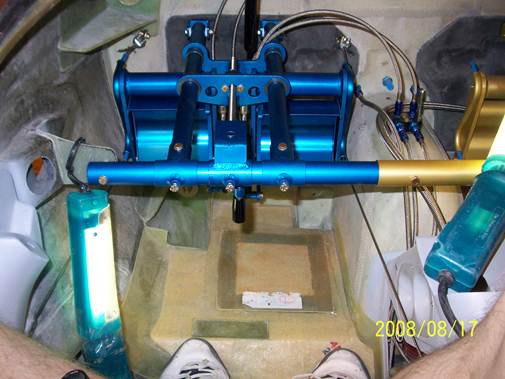
Figure 25 -- Floor Board in Place
There is also room to have the floor boards and an avionics shelf mounted across the upper engine gussets. The floorboards do take up about 2 inches of vertical leg room and do not allow enough room below the pedals to stretch one’s legs underneath during cruise. Figure 26 shows the clearances for big size 12 wedge sole running shoes on the rudder pedals with the floor boards in place.
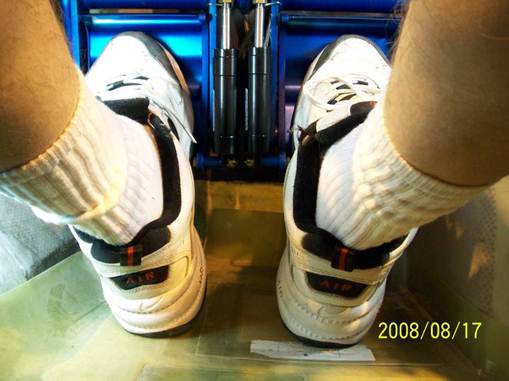
Figure 26 -- Big Shoe Rudder Pedal Clearance with Floor Boards in Place
There are conflicting opinions on whether or not the floor boards are required for necessary structural strength or just to provide a mounting surface for the floor mounted rudder pedals sold by Lancair. Lancair’s General Manager during the Legacy’s development, Bob Fair, provided a response to this question by email show below.
From: C FAIR [mailto:FairRobert@msn.com]
Sent: Tuesday, July 01, 2008 11:09 AM
To: Valin & Allyson Thorn
Subject: Re: Hi Bob
Hi Valin,
I no longer have any structural information on the Legacy. I do know that the floor boards have nothing to do with the structural strength, they were to hold the old pedals. Your pedals are great and if I was doing a new plane we would be talking.
Anything I can do to help let me know.
Bob
Carsten Sundin was the Legacy Development Project Manager. Carsten does not remember the floor boards being a consideration in the air frame’s structural design – however, he said they were in place during the structural testing.
Mark Mahnke was Lancair’s Build Shop Manager during the Legacy’s development and we discussed this subject at Oshkosh 2008 and in a follow up phone conversation. Mark observed the Legacy’s structural testing and is recommending that the floor boards, or some reinforcement around the engine gussets, be installed for additional structural strength.
Mark’s recount of Legacy Structural Testing
Mark recounted his observation of the Legacy’s structural testing to failure. Not all of this relates directly to the floor boards – but it is interesting and is included…
Mark said that for the positive acceleration (g) testing that at 8 g’s the airframe started getting some cracking on the sides of the fuselage above the main spar. So, they stopped the test and reinforced that area. The reinforcement can be seen in today’s fiberglass reinforcement above and forward of the area above the main spar. This load reinforcement piece was present in the test – it just didn’t extend as far forward.
Note that even though the Legacy’s design operating g limits are +4.4 g utility, +3.8 g normal category, structural designers apply strength margins above the design operating limits to account for uncertainty in materials, builder technique, environment, etc. to ensure safety. The standard factor of safety for aircraft structural design is 1.5 – which would require a minimum ultimate strength at a 6.6 g load factor.
The load testing was continued and at between 10 to 11 g’s the lower engine mounts (under a compression load) began pushing the G10 pad (light green/brown Phenolic) core through the firewall engine mount gusset base. At the same time the top engine mounts (under a tension load) began to pull through of the firewall. At complete failure all this broke free and the air frame crashed to the ground which broke the tail off. Mark said the tail didn’t come off as part of the test – it broke when the fuselage with all this energy bounced off the ground.
Mark feels most comfortable with some floor board type reinforcement around the lower engine mount gussets. In recognition of the loss of leg room this creates, for Ralph Love’s Legacy, he modified the floor boards to preserve the structural reinforcement they provide and minimize the leg room impact. He recognizes that additional reinforcement in the area can be provided without having to use the floor boards. He also said his mod can also be set to a smooth slope transition for the fuselage floor rather than the sudden chop/drop off he used on Ralph’s Legacy. Figure 27 shows Ralph Love’s Legacy with Mark Mahnke’s floor board modification.
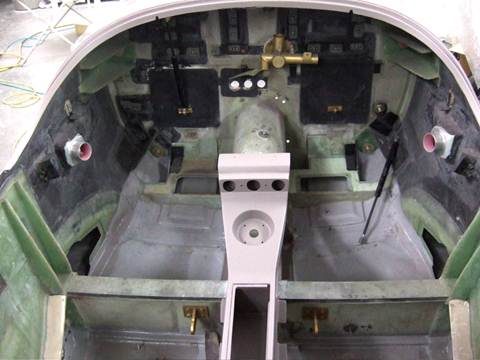
Figure 27 -- Mark Mahnke's Floor Board Modification
Each builder should consider these opinions as they decide for themselves whether or not they wish to install the floor boards, reinforce the lower firewall engine mounts in a different way, or simply eliminate the floorboards.
From: Lancair Mailing List [mailto:lml@lancaironline.net] On Behalf Of Ralph Love
Sent: Tuesday, February 26, 2013 5:47 AM
To: lml@lancaironline.net
Subject: [LML] Re: Legacy seat cushions/Knee clearance
But beware, Mark Mankhe considers the floor panel part of the structural integrity of the plane. In my case we cut the panels in half to maintain the structural benefit but I can now get my heels on the floor. I installed the overhanging rudder pedals from the fixed gear Legacy(I think) which can only be adjusted on the ground with some effort.
Another mod that helps GREATLY with shin clearance are the Thorn Rudder Pedals. These allow you to remove the now unneeded raised floor panels. The improvement in leg room is nothing short of dramatic. You wouldn't think that only lowering the floor a couple inches would be so significant, but it truly is. The genesis of this product was to find enough leg room for taller pilots, but even average height folks will like it.
Of course, this project is easier if done while building. Still, I did it after the fact, and I am really, really pleased with it. The ability to stretch one's legs (all the way to the firewall) makes a huge difference on long flights. You can even cross your legs. I could NEVER do this before installing these rudder pedals. Now, my Legacy has fantastic looks, visibility, speed, handling, efficiency, and it is COMFORTABLE!
Sufficient leg room is like the final (only?) design issue that needed to be addressed. These rudder pedals totally take care of that last remaining item.
Legacy
On Feb 22, 2013, at 1:50 PM, Steve Colwell wrote:
The minimum behind your cheeks seat clearance can be obtained with Oregon Aero’s custom fit, computer cut, temper foam cushions for the Legacy. The shape of the aft spar/seat pan is more complex than most upholstery shops can fit. Several Legacies have been refitted with the Oregon Aero cushions for comfort alone. http://www.oregonaero.com/products/lancair-legacy-un-upholstered-cushion-core Not cheap, but less expensive than doing it twice.
I agree. Removing the back seat cushion is SOP when chauffeuring anyone over ~6'2"
Joe Czabaranek
Excuse me if I am telling you something you already know… but my experience is that a thinner seat BACK had a much great impact on the knee-to-panel clearance. My initial experiments with seat bottom cushion were disappoint, and then one day I modified the seat back cushion and my situation was greatly improved.