Mailing List flyrotary@lancaironline.net Message #47779
From: Bill Schertz <wschertz@comcast.net>
Subject: Water Pump efficiency and performance part 1
Date: Tue, 18 Aug 2009 16:34:21 -0500
To: Rotary motors in aircraft <flyrotary@lancaironline.net>
Too big to send at once, so this is split into two submissions with different attachments
Bill Schertz
KIS Cruiser #4045
N343BS
Phase I testing
----- Original Message -----
Sent: Tuesday, August 18, 2009 4:29 PM
Subject: Re: [FlyRotary] Re: Swirl pots/box fans

At the risk of inserting some data, see the attached chart. This is for a LARGE centrifugal pump, but they all work in a similar mode. Please note that Curve D represents the pressure generating capability of the pump as a function of flow rate,
 
Curve A shows that when you throttle back a pump, the water temperature going through the pump rises (the energy has to go somewhere)
Point B is the maximum pressure that the pump can generate
 
Curve C is the efficiency of the pump. At full throttle (zero flow) the efficiency is zero
 
Curve E is the brake horsepower absorbed by the pump. The horsepower delivered to the water as useful work (i.e. pumping water) is labeled Water H.P. and is brake HP * Efficiency. This graphically shows what Tracy was saying.
 
Years ago, I measured the flow vs. pressure for the Mazda 13-B engine pump, with it pumping through the block. the article is attached
 
 
Bill Schertz
KIS Cruiser #4045
N343BS
Phase I testing
----- Original Message -----
Sent: Tuesday, August 18, 2009 2:22 PM
Subject: [FlyRotary] Re: Swirl pots/box fans

Here is a formula for a centrifugal pump that clearly? Shows that Tracy and Lynn are correct


Energy Usage

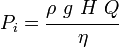
The energy usage in a pumping installation is determined by the flow required, the height lifted and the length and characteristics of the pipeline. The power required to drive a pump (Pi), is defined simply using SI units by: by:
P_i= \cfrac{\rho\ g\ H\ Q}{\eta}

where:

Pi is the input power required (W)

ñ is the fluid density (kg/m3)

g is the gravitational constant (9.81 m/s2)

H is the energy Head added to the flow (m)

Q is the flow rate (m3/s)

ç is the efficiency of the pump plant as a decimal


One can see that if Q the flow rate becomes zero (by blocking the exit) then the power required to drive the pump Pi also becomes zero.  So block the pump and lower the flow and the power required drops – or with the same power, the pump can spin faster.  There is always some flow around the vanes of a centrifugal pump in reality, so the power does not cause the pump to spin to infinity rpm but it equalizes at a higher rpm than when considerable (unblocked) flow is the condition.


Is this fun or what?


From: Rotary motors in aircraft [mailto:flyrotary@lancaironline.net] On Behalf Of Lynn Hanover
Sent: Tuesday, August 18, 2009 2:55 PM
To: Rotary motors in aircraft
Subject: [FlyRotary] Swirl pots/box fans


NO!  I meant exactly what I wrote.  It is admittedly counter-intuitive but true none the less.  Did you attempt to prove it to yourself with the suggested test?   Only takes a few seconds :>)

Tracy

On Tue, Aug 18, 2009 at 11:57 AM, Jeff Luckey <JLuckey@pacbell.net> wrote:

Tracy,


When a box fan falls over onto its suction side, it revs up as the work it is performing drops off to near zero.....................same idea.


Lynn E. Hanover


__________ Information from ESET NOD32 Antivirus, version of virus signature database 3267 (20080714) __________

The message was checked by ESET NOD32 Antivirus.

http://www.eset.com
Subscribe (FEED) Subscribe (DIGEST) Subscribe (INDEX) Unsubscribe Mail to Listmaster