|
I just don't know a safe way to do the strobe thing, unless you removed
prop. Ideally you would want to use it under load and high rpm. Maybe you could
tape it in place, turn on video, then fire up engine. Just would need to tweak
strobe frequency to show exhaust movement.
I volunteer at science museum physics lab. It is unreal to see vibration
with strobe. I use it on water filled glasses. Also on "Chinese dancing water
bowl", where you rub bowl handle with hands and it severely bends and splashes
water due to harmonic vibration.
Only a couple weeks ago, I read the specs for this slip fit. I can't find
source. It was some EAA book I think. I have no leakage with a 2-3"
long slip fit. You want the smaller diam tube to be up stream, so a leak would
have to reverse flow direction. Does that make sense?
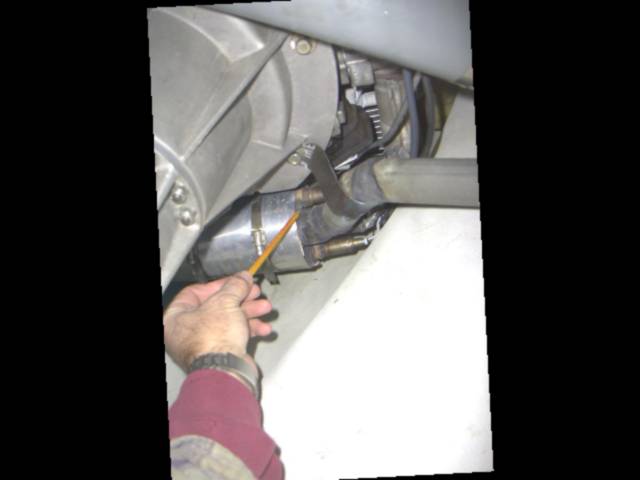
The attached pic does not show the slip
fit. Slip is directly behind the pipe coming out of the muffler,
so you can't see it. But basically that large diam muffler section can rotate.
Only the fastener attached to psru stops it from rotation.
Slip fit changes exhaust freq response, eliminates axial forces. Unsure if
it will help your situation. Something to consider. Those exhaust ball joints
accomplish the same.
Appreciate the positive feedback. Very rare.
Al,
That strobe is a great
idea!
I'm going to do that. I
appreciate all the knowledge you share.
I'd like to see a pic of
your slip fit exhaust. It seems to me I could use a heavy piece of header pipe
that goes all the way into the muffler and a smaller walled piece for the slip
fit with maybe a three inch overlap.
How do you stop the gases
from leaking past the slip fit?
Thanks!
Ben
Acroduster Too (still
building)
20B
----- Original Message -----
Sent: 07/26/2006 5:56 PM
Subject: [FlyRotary] Re: Inconel
I have a lot of experience with failure analysis. Used to do it with
GM, Ford, other warranty returns. One of my favorite experiences was solving
a million $ warranty issue on a tubing product. Although I'm not expert in
this area, I'd sure encourage considering other factors, other
solutions.
In particular I'd encourage use of strobe lamp. Take cowl off, fire up
engine, use strobe. (yes, it's dangerous with prop on) You will suddenly
have appreciation for the forces involved. You should be able to predict
failure points with this test. Tack together the broken one to see what
I mean.
The exhaust will turn into a sine shape at certain rpm. You will see
huge amount of movement on the busted one. Make a new design, compare
movement to predict how long it will last. A very minor design change can
greatly improve how much movement occurs.
I'm not sure this is applicable to you guys, but my exhaust design has
slip fit of two pipes instead of welding. It works phenomenal. I've had
conversation with other guys who welded instead and had failures. Same exact
application. So my exhaust floats in relation to the header. I just attach a
small bracket to the floating portion to prevent if from blowing off.
Truthfully, I never expected it to work, but it has quite well. I might have
pic if verbal description not adequate.
-al wick
Artificial intelligence in
cockpit, Cozy IV powered by stock Subaru 2.5
N9032U 200+ hours on
engine/airframe from Portland, Oregon
Prop construct, Subaru install, Risk
assessment, Glass panel design
info:
http://www.maddyhome.com/canardpages/pages/alwick/index.html
OXYSEN~1.JPG
|