|
Bill,
I did some research on the K&N site - they have
a formula for determining filter area needed - the trouble is there is no
correlation (I could find) between the area you calculate and the surface area
of their filters. So I just did a rough calculation of their filters
surface area based on small end - large end and length. On their double
cone types I assume the inner cone is only 10% the area of their outer cone
(which is probably very conservative). I used the 160 CID 4 stroke
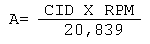
equivalent displacement area for the 13B and the below formula. Which gave
me at 7000 rpm a minimum of 53 sq inches required.
Then I did the calculation using the attached
spreadsheet to compare their different size filters for area - since they don't
give it. Attached is the spreadsheet for using the below formula and the
calculations for a truncated cone surface area.
Use the formula below to compute the minimum size
filter required for your particular application. The usable portion of the
filter is called the EFFECTIVE FILTERING AREA which is determined by multiplying
the diameter of the filter times Pi (3.1416) times the height of the air filter
in inches, then subtracting .75-inch. We subtract .75-inch to compensate for the
rubber seals on each end of the element and the filter material near them since
very little air flows through this area.
|
|
A = effective filtering area
CID = cubic inch displacement
RPM
= revolutions per minute at maximum power
|
| Example: A 350 CID Chevy engine with a horsepower peak at 5,500
rpm. |
|
|
Ed A
----- Original Message -----
Sent: Monday, April 18, 2005 5:54
PM
Subject: [FlyRotary] Re: Air
filters
If one looks at the K&N cone filters, how big
a one is required?
Bill Schertz (really tight under my cowl)
KIS Cruiser # 4045
affform1.gif

affform2.gif
|