|
|
In a message dated 10/6/2004 5:25:14 PM Central Daylight Time, Dastaten@earthlink.net writes:
<< 1) be patient and deliberate. The porting templates are thin aluminum, and it is very easy to grind/cut beyond the scribe lines provided byRading Beat. 2) The intake template is a "one size fits all" approach. The housings have some difference in water jacket configuration and as a result you need to pay attention to detail or you WILL breach a water jacket if you just grind away all the metal the port template prescribes. Take your finger and feel behind the polished surfaces by reaching through the water jacket holes and you will see what I am referring to (on the turbo intermediate housing). On the NA intermediate housing there is some sort of plenum chamber that is connected to the intake that has a lot of cast metal there. The NA intermediate housing is able to be ground away completely within the outline of the porting template if you contour it.
3) be patient and deliberate. You cant replace metal you have ground away, and when you are nearing the edges of the area you are porting, it is VERY easy to slip and score/grind the polished surface and damage the chrome/polished surface.
4) The streetable exhaust port doesn't prescribe for much metal removal. You would do well to get Turbo rotor housings that do not have the diffuser in the exhaust stream (Bruce Turretine recommends this in his video as a performance upgrade)
I will post some pics later. I am working an awful lot this week, and I just spent two days offline because a storm toasted my cable modem, soI am playing catchup.
Dave Staten
Houston, TX
Go to the "No pistons" web page and look through the archives at porting pics. http://www.nopistons.com/forums/index.php?showtopic=33568
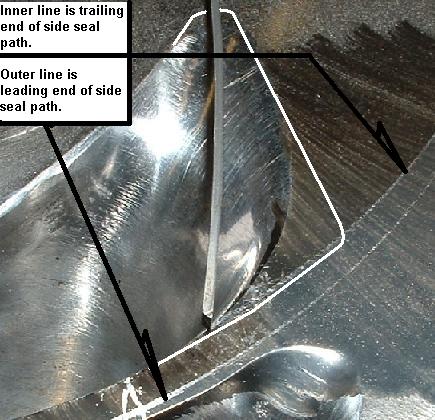
Ink up one of the end irons around the port with a Magic marker. Bend the end of a side seal spring into a 90 degree angle so it sticks up out of the seal slot, and install it against a corner seal. Install the crank and stationary gear and turn the engine backwards, so that the side seal spring scribes a line coincident with the side seal/corner seal junction.
You will then have a line indicating the path of the advancing end of the side seal, and that line shows you where the center (about) of the corner seal path will be. If your port is kept about a sixteenth of an inch inboard of this line, all will be well. The trailing end of the side seal will not be supported when crossing the port opening. Not a problem. You will want to radius and polish the whole closing line at the top of the port. This will let the trailing end of the side seal back onto the iron in a smooth motion and no damage will occur. Leave the inside of turns as cast, or if that bothers you, just knock down the high spots with a flapper wheel, and polish the outside of turns like chrome. The closing line is just like the intake valve closing point on a piston engine. Go to Paul Yaw's web site to see street port pics. http://www.yawpower.com/
He also has the very best tech articles on how the rotary works.
Go to the rotary engine illustrated site: http://www.rotaryengineillustrated.com/RE101pages/4-ports101.html and watch one run until the 4 Otto cycles are obvious. Then pick a closing point and start grinding and polishing. You will be hard pressed to keep it under 300 HP.
In this picture the white line is where I ended up shape wise. While the closing line is technically at 85 degrees ATDC, the port is very shallow along the closing line, and the squared off shape is there to get the unsupported trailing end of the side seal back on the flat of the iron with a long smooth motion. The original port shape was pinching the end of the seal where the line came back onto the iron in that curved part of the port. This engine is in the car now, and it screams. I am very happy with it. The line closer to the outside of the engine, is the leading end of the side seal. There are porting masks available that will have both ends of the side seal unsupported, and the engine will be very powerful, but the seal will wear into a rounded off shape and loose compression rather quickly. Since most airplane people would rather fly than look into an engine on a monthly basis, I would avoid those ports. If you follow the above you will be good to go for a very long time and you will have proved the pudding before you start.
Lynn E. Hanover
Lynn E. Hanover
Designweb.jpg
|
|